

UPC: 3700398718149
Format: LP
Regular price
€34,95 EUR
Regular price
Sale price
€34,95 EUR
Unit price
per
Couldn't load pickup availability
FREE SHIPPING
This item is currently out of stock and may be on backorder.
Personnel: Elliot Murphy (vocals, guitar, harmonica, organ); C.T.S. (vocals); Brian Ritchie (guitar, bass); David Johansen (harmonica); Peter Gordon (saxophone); Richard Sohl (keyboards); Ernie Brooks (bass, background vocals); Tony Machine (drums, percussion).
Recorded at Battery Sound, New York, from 1983-1984. Includes liner notes by Elliot Murphy.
All songs written by Elliot Murphy.
PARTY GIRLS/BROKEN POETS was released in Europe in 1984, but not released in the United States until 1992. This US edition features 2 previously unreleased tracks.
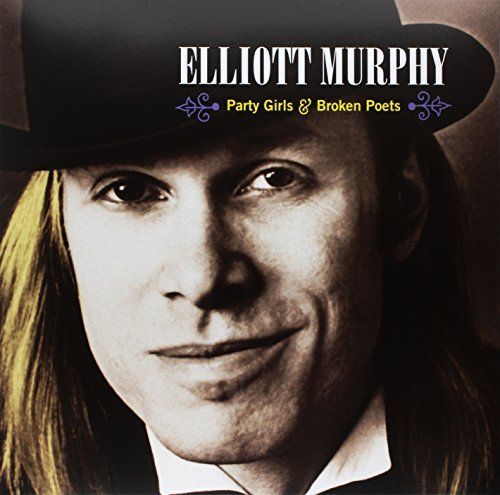
Party Girls & Broken Poets is an elegant album by underground visionary Elliott Murphy. The black-and-white cover on gold and white gives a hint to the music inside. The first portion of the album takes a while to kick in, until the third song, "Dr. Calabash." It's a real grabber that is perhaps the strongest track here. With co-production and bass supplied by ex-Modern Lover Ernie Brooks, the sensibilities are in place, but what's missing from Murphy's music is that little extra edge that early Jonathan Richman contained -- the spark caught from obsession with the Velvet Underground. "Something New" is a perfect example of how the artist can sometimes miss the mark. It's a cute little pop tune, but it doesn't have the magnetism of, say, the Modern Lovers' "Astral Plane" or Johnny Thunder's "In Cold Blood." "Last Call" is a fine song with a wonderful hook. It may be what inspired Murphy's French recording company to call themselves Last Call Records; previously they were New Rose taken from the Damned song of the same name. The title track, "Party Girls and Broken Poets," is nicely insightful, and "Like a Rocket" has its moments as well. Guest appearances by David Johansen and Violent Femmes' Brian Ritchie on "Blues Responsibility" still can't keep it from sounding like John Cougar Mellencamp, and for Elliott Murphy's audience, that's not a plus. On "The Streets of New York," the poet sees "only people." Don't believe it for a moment -- he sees a lot more than people, but it might take a Bob Ezrin or Jack Douglas old-school producer to help him refine that intuition. He's an interesting and prolific artist with a fan base, and this is a worthwhile recording nonetheless. ~ Joe Viglione
Recorded at Battery Sound, New York, from 1983-1984. Includes liner notes by Elliot Murphy.
All songs written by Elliot Murphy.
PARTY GIRLS/BROKEN POETS was released in Europe in 1984, but not released in the United States until 1992. This US edition features 2 previously unreleased tracks.
Party Girls & Broken Poets is an elegant album by underground visionary Elliott Murphy. The black-and-white cover on gold and white gives a hint to the music inside. The first portion of the album takes a while to kick in, until the third song, "Dr. Calabash." It's a real grabber that is perhaps the strongest track here. With co-production and bass supplied by ex-Modern Lover Ernie Brooks, the sensibilities are in place, but what's missing from Murphy's music is that little extra edge that early Jonathan Richman contained -- the spark caught from obsession with the Velvet Underground. "Something New" is a perfect example of how the artist can sometimes miss the mark. It's a cute little pop tune, but it doesn't have the magnetism of, say, the Modern Lovers' "Astral Plane" or Johnny Thunder's "In Cold Blood." "Last Call" is a fine song with a wonderful hook. It may be what inspired Murphy's French recording company to call themselves Last Call Records; previously they were New Rose taken from the Damned song of the same name. The title track, "Party Girls and Broken Poets," is nicely insightful, and "Like a Rocket" has its moments as well. Guest appearances by David Johansen and Violent Femmes' Brian Ritchie on "Blues Responsibility" still can't keep it from sounding like John Cougar Mellencamp, and for Elliott Murphy's audience, that's not a plus. On "The Streets of New York," the poet sees "only people." Don't believe it for a moment -- he sees a lot more than people, but it might take a Bob Ezrin or Jack Douglas old-school producer to help him refine that intuition. He's an interesting and prolific artist with a fan base, and this is a worthwhile recording nonetheless. ~ Joe Viglione